

🇺🇲 Analysis - Cuba as a Platform for Adversarial Power Influence in the Western Hemisphere
Idabell Rosales, Guest Analyst, MSI²

The Strategic Convergence of China, Russia, and Iran at the Geopolitical Threshold of the United States
Executive Summary
Less than ninety miles from the coast of Florida, Cuba has ceased to be a geopolitical remnant of the Cold War and has become a strategic hub from which China, Russia, and Iran project intelligence capabilities, military cooperation, political influence, and technological assets throughout the Western Hemisphere. The convergence of signals intelligence (SIGINT) infrastructure, military cooperation, dual-use technologies, and sharp power operations (authoritarian penetration and influence) represents one of the most significant strategic challenges to U.S. national security in the Caribbean since the collapse of the Soviet Union. Available evidence indicates that these activities are not isolated initiatives but rather components of a sustained great-power competition strategy aimed at expanding the influence of authoritarian regimes within the United States’ immediate geopolitical environment (Center for Strategic and International Studies [CSIS], 2024; Office of the Director of National Intelligence [ODNI], 2026).
Why It Matters
For much of the first two decades of the twenty-first century, Washington’s strategic attention remained focused on Afghanistan, Iraq, the fight against terrorism, and, more recently, the Indo-Pacific. Yet while the United States directed its attention toward other theaters, its principal geopolitical competitors seized the opportunity to consolidate positions across Latin America through investment, technological cooperation, military agreements, and political influence campaigns. Today, Cuba occupies a privileged position within that strategy.
Its geographic location, the authoritarian nature of its regime, its extensive experience in intelligence and counterintelligence, and its willingness to cooperate with adversarial actors make the island an exceptional platform for the projection of extraregional power. As Dr. Rafael Marrero has argued in research conducted by the Miami Strategic Intelligence Institute (MSI²), China’s growing presence in Latin America should be understood as part of a long-term strategy designed to expand the Chinese Communist Party’s geoeconomic, technological, and informational influence (Marrero & Gutiérrez, 2026). Cuba represents one of the most sensitive components of that architecture.
Key Judgments
Cuba has reemerged as a frontline theater in great-power competition in the Western Hemisphere.
China, Russia, and Iran are developing complementary strategic relationships with Cuba, creating a force-multiplying ecosystem rather than isolated partnerships.
China’s intelligence infrastructure in Cuba significantly enhances its ability to collect military, commercial, and space-related intelligence near the U.S. mainland.
Cuba contributes far more than geography by providing intelligence expertise, political influence networks, and decades of experience in authoritarian statecraft.
The convergence of intelligence, military cooperation, technology, and sharp power creates a cumulative strategic risk that requires a coordinated U.S. response.
The Caribbean has once again become a contested strategic theater requiring sustained attention from policymakers, intelligence agencies, and regional allies.
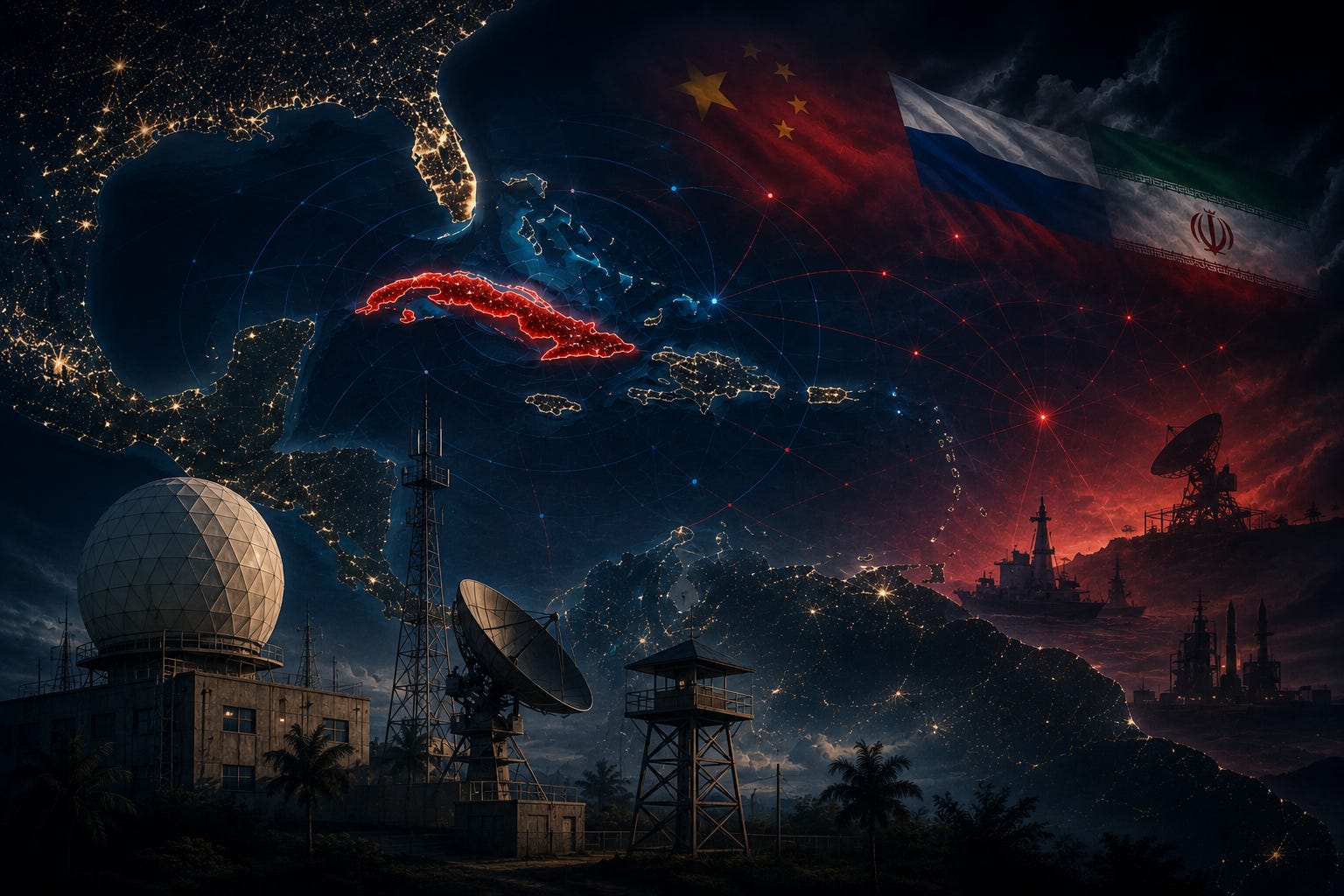
Evidence compiled by U.S. government agencies, research institutions, and specialized analysts supports several fundamental conclusions. First, China has developed an intelligence infrastructure in Cuba that is considerably more sophisticated than was estimated only a few years ago. Second, Russia continues to revitalize its military cooperation with Havana, while Iran is adding asymmetric capabilities that complement the strengths of both partners. Finally, Cuba provides an asset that none of them can replicate: a geographic platform located in close proximity to the U.S. mainland and a state apparatus experienced in intelligence operations, political influence, and social control.
More importantly, these capabilities should not be analyzed independently. Their interaction creates a force-multiplying effect that significantly enhances the collective capacity of these actors to collect intelligence, influence Latin American governments, and project strategic power throughout the Caribbean.
Cuba and the Return of Great-Power Competition
Strategic history demonstrates that Cuba’s geopolitical importance has never depended on its territorial size or economic weight, but rather on its geographic location. Since the colonial era, the island has served as a control point over the principal maritime routes of the Gulf of Mexico and the Caribbean. During the Cold War, that position acquired existential significance for the United States with the 1962 Cuban Missile Crisis. Today, more than six decades later, Cuba once again occupies a central position in great-power competition, albeit under considerably different circumstances.
Contemporary rivalry is no longer confined to the deployment of strategic weapons. It now unfolds through digital infrastructure, electronic intelligence, dual-use technologies, port investments, telecommunications, logistics networks, and political influence campaigns. As noted by renowned scholar Evan Ellis, the People’s Republic of China’s strategy in Latin America extends far beyond trade and investment. Beijing seeks to build structural relationships that progressively expand its political, economic, and military access throughout the region, creating dependencies that may eventually translate into strategic advantages (Ellis, 2022).
From this perspective, Cuba represents an exceptional strategic asset. No other Latin American country simultaneously offers geographic proximity to the United States, Cold War-era infrastructure, an established intelligence apparatus, and such a strong political willingness to cooperate with actors that challenge the international order led by Washington.
This interpretation aligns with research conducted by the Miami Strategic Intelligence Institute on the concept of Chinese Social Imperialism, through which Dr. Rafael Marrero and José Adán Gutiérrez describe the coordinated use of economic, technological, diplomatic, and informational instruments by the Chinese Communist Party to expand its global influence without necessarily resorting to the direct use of military force (Marrero & Gutiérrez, 2026). Within this analytical framework, China’s presence in Cuba is not an anomaly but rather a logical extension of a much broader hemispheric strategy.
China’s Intelligence Architecture
The publication by the Center for Strategic and International Studies in December 2024 substantially reshaped public understanding of the scope of Chinese intelligence activities in Cuba. Based on commercial satellite imagery, geospatial analysis, and systematic observation of critical infrastructure, CSIS documented the existence of at least four principal facilities dedicated to electronic intelligence activities: Bejucal, El Salao, Wajay, and Calabazar (CSIS, 2024).
Bejucal remains the best-known complex. Its antennas, underground facilities, and interception systems enable the monitoring of U.S. military communications, satellite links, and aerospace activities. Of particular concern is its potential capability to observe launches from Cape Canaveral and other strategic installations located in the southeastern United States.
More recently, analysts have shifted their attention toward El Salao, where satellite imagery has revealed the construction of a large Circularly Disposed Antenna Array (CDAA). This type of infrastructure is traditionally used to locate high-frequency radio emissions across great distances, enabling the identification of military and civilian communications throughout the Caribbean, the Atlantic, and portions of the American continent.
The facilities at Wajay and Calabazar complement this architecture through capabilities focused on satellite monitoring, ground-based interception, and support for technical intelligence operations. Although many of their specific capabilities remain classified, the convergence of CSIS analysis and the U.S. Intelligence Community’s Annual Threat Assessment reinforces the conclusion that China continues to systematically expand its intelligence collection capabilities from Cuban territory (ODNI, 2026).
What is truly significant is not merely the existence of these facilities, but their integration into a much broader regional strategy. Over the past two decades, Beijing has invested in ports, telecommunications networks, energy infrastructure, digital systems, space cooperation, and technological projects across virtually all of Latin America. As a result, the intelligence capabilities developed in Cuba benefit from a regional infrastructure network that substantially expands the strategic reach of Chinese operations.
This reality explains why senior officials at U.S. Southern Command have warned that China’s growing presence in the Western Hemisphere must be analyzed from a comprehensive strategic perspective rather than viewed solely through an economic lens. Dual-use infrastructure (civilian in appearance but readily adaptable for military or intelligence purposes) represents one of the region’s foremost strategic challenges.
Russia, Iran, and the Consolidation of an Adversarial Strategic Ecosystem
While China serves as the primary economic and technological engine of this emerging architecture, Russia and Iran contribute complementary capabilities that significantly broaden its strategic reach. Rather than competing with one another, the three actors appear to operate under a framework of tactical convergence in which each contributes distinct strengths that collectively erode the United States’ strategic position in the Western Hemisphere.
Russia has maintained a privileged relationship with Cuba since the Cold War and, despite the collapse of the Soviet Union, never completely abandoned its geopolitical interest in the island. Russia’s invasion of Ukraine in 2022 and the resulting deterioration of relations between Moscow and the West accelerated a renewed rapprochement with Havana. In recent years, visits by Russian warships to the Caribbean, defense cooperation agreements, and high-level exchanges between military officials have reflected the Kremlin’s determination to preserve a strategic presence just off the U.S. mainland (ODNI, 2026).
Although Russia’s military capabilities in the Caribbean fall far short of those maintained during the Soviet era, their strategic value should not be measured solely in quantitative terms. As analyst Mark Galeotti has explained, Moscow now favors a strategy of selective, flexible, and politically symbolic presence designed to project influence with relatively limited resources. Within that framework, Cuba continues to represent a diplomatic and military foothold of considerable importance to Russian foreign policy.
Iran, for its part, has gradually expanded its presence in Latin America through a combination of diplomatic cooperation, technological assistance, commercial relations, and political alliances. Although its physical presence in Cuba is less visible than that of China or Russia, multiple studies suggest that Tehran seeks to consolidate a network of relationships that expands its strategic maneuvering room in the face of Western pressure. Analyst Joseph Humire has extensively documented how Iran’s regional strategy combines diplomatic, economic, religious, and security instruments to build long-term political influence.
Reports published during 2026 regarding the possible incorporation of Russian- and Iranian-made drones into Cuba’s military inventory have generated particular concern. Although much of this information remains subject to the limitations inherent in open-source intelligence, U.S. officials have expressed concern about the potential use of these platforms to expand the island’s surveillance, reconnaissance, and even strike capabilities (Axios, 2026). In an environment characterized by the rapid evolution of unmanned technologies, even limited capabilities could alter strategic calculations related to the protection of critical infrastructure, military installations, and maritime routes in the Florida Straits.
Beyond the individual capabilities of each actor, the truly novel aspect lies in the growing complementarity of their efforts. China provides financial resources, technological infrastructure, and advanced intelligence capabilities; Russia contributes military expertise, defense cooperation, and diplomatic backing; Iran supplies asymmetric warfare tools and political cooperation networks. Cuba serves as the geographic and institutional facilitator that integrates these instruments within a single strategic space.
Cuban Sharp Power: The Less Visible Dimension of Strategic Competition
Limiting the analysis of Cuba to its military or intelligence capabilities would be a mistake. The Cuban regime also possesses decades of experience in employing political and ideological instruments to influence regional actors, a capability that effectively complements the strategic objectives of its extra-regional partners.
The concepts developed by Christopher Walker and Jessica Ludwig regarding sharp power provide a particularly useful framework for understanding this phenomenon. Unlike soft power, which relies on cultural attraction and persuasion, sharp power employs information manipulation, institutional penetration, propaganda, censorship, and disinformation to shape political perceptions and weaken democratic institutions.
For decades, Cuba has cultivated a sophisticated network of political, academic, labor, and cooperative relationships throughout Latin America. This experience constitutes a strategic asset that China, Russia, and Iran can leverage to amplify their own narratives and expand their regional influence. From this perspective, the island provides not only physical infrastructure for intelligence activities but also political capital accumulated over more than six decades of international activism.
As Dr. Rafael Marrero has argued in numerous analyses published by MSI², contemporary strategic competition is waged simultaneously across the economic, technological, informational, diplomatic, and cognitive domains. Influence no longer depends exclusively on the deployment of military forces; it is also built through the ability to shape narratives, influence political elites, control critical infrastructure, and create technological dependencies. Cuba continues to play a relevant role precisely because it contributes to this less visible dimension of geopolitical competition (Marrero & Gutiérrez, 2026).
Cuba Within China’s Hemispheric Strategy
Professor Evan Ellis’s research consistently concludes that China’s strategy in Latin America reflects a comprehensive, long-term vision. Rather than pursuing immediate economic gains alone, Beijing seeks to build a regional architecture that facilitates its access to markets, natural resources, strategic infrastructure, critical technologies, and spheres of political influence (Ellis, 2022).
This interpretation converges with Dr. Rafael Marrero’s concept of Chinese Social Imperialism, which argues that the Chinese Communist Party employs ostensibly civilian instruments, including investment, financing, digital infrastructure, telecommunications, and technological cooperation, to gradually expand its influence over foreign governments and societies. Within this framework, the intelligence infrastructure observed in Cuba represents only one visible component of a much broader hemispheric strategy.
Ports operated by Chinese state-owned enterprises, telecommunications networks, energy projects, space facilities, artificial intelligence cooperation, and infrastructure financing form part of an ecosystem that progressively expands Beijing’s strategic presence across the continent. Cuba stands out within that architecture not only because of its geographic location but also because of the convergence of political, military, and ideological capabilities that would be difficult to replicate elsewhere in the region.
In this context, a recent observation by George Friedman is particularly relevant. He has argued that, from the standpoint of U.S. national security, Cuba possesses even greater strategic importance than Venezuela because of its geographic proximity and its potential as a platform for intelligence collection and power projection by extra-regional actors. Although both situations present distinct challenges, the evidence analyzed in this study supports assigning Cuba renewed priority within U.S. hemispheric strategic planning.
Strategic Assessment
The principal conclusion of this study is that the United States no longer faces a collection of separate challenges originating from China, Russia, or Iran. Instead, it confronts an integrated ecosystem of strategic competition in which these actors cooperate, formally or informally, to expand their presence and influence throughout the Western Hemisphere.
China provides technological capabilities and intelligence infrastructure. Russia contributes military expertise, defense cooperation, and political deterrence. Iran supplies irregular warfare tools and asymmetric support networks. Cuba provides the geographic space, institutional infrastructure, and intelligence expertise necessary to integrate these elements into an operational platform located within the immediate strategic environment of the United States.
From the perspective of the Miami Strategic Intelligence Institute, this convergence represents one of the most consequential geopolitical developments observed in the Caribbean since the end of the Cold War. Its significance lies not only in the current capabilities of these actors but also in the cumulative potential they could achieve should the trends observed in recent years continue to consolidate.
Conclusion
The available evidence confirms that Cuba has regained a level of strategic relevance that far exceeds its limited economic dimension. The island has once again assumed a central position in great-power competition, facilitating the simultaneous presence of China, Russia, and Iran in a geographic space of extraordinary importance to U.S. national security.
Research conducted by CSIS, assessments produced by the U.S. Intelligence Community, and the contributions of specialists such as Evan Ellis, Joseph Humire, Christopher Walker, and George Friedman converge on a fundamental conclusion: the Caribbean has once again become a priority theater of twenty-first-century geopolitical competition. Research conducted by the Miami Strategic Intelligence Institute expands upon that conclusion by placing the presence of these powers within a broader process of geoeconomic and technological expansion driven by authoritarian regimes.
Ignoring this transformation would mean interpreting today’s challenges through conceptual frameworks inherited from the previous century. Understanding Cuba’s strategic evolution requires recognizing that contemporary competition is no longer confined to conventional military power. It unfolds simultaneously across the domains of intelligence, technology, economics, critical infrastructure, and information. Within this new environment, Cuba has ceased to be a peripheral actor and has once again become a central piece on the hemispheric strategic chessboard.
References
Axios. (2026, May 17). Exclusive: U.S. Eyes Attack-Drone Threat From Cuba.
Center for Strategic and International Studies. (2024). China’s Intelligence Footprint in Cuba: New Evidence and Implications for U.S. Security.
Ellis, R. E. (2022). China Engages Latin America: Distorting Development and Democracy? Lynne Rienner Publishers.
Humire, J. (2022). Iran’s Strategic Penetration of Latin America. Center for a Secure Free Society.
Ludwig, J., & Walker, C. (Eds.). (2017). Sharp Power: Rising Authoritarian Influence. National Endowment for Democracy.
Marrero, R., & Gutiérrez, J. A. (2026). Chinese Social Imperialism: The CCP’s Expanding Footprint in Latin America. Bravo Zulu Publishers.
Office of the Director of National Intelligence. (2026). Annual Threat Assessment of the U.S. Intelligence Community.
The Wall Street Journal. (2026). U.S. Warns of Growing Russian and Chinese Spying in Cuba.
Author
Idabell Rosales is Principal of Idabell Solutions LLC, a U.S. woman-owned consulting firm specializing in democracy promotion, civil society development, and humanitarian assistance in Cuba and Latin America. With more than 14 years of experience managing federally funded and nonprofit programs, she specializes in strengthening civic resilience, advancing freedom of expression, and supporting democratic participation in restrictive environments. Her expertise also includes federal proposal development, democracy programming, and governance strategies that support freedom, transparency, and democratic resilience in the Western Hemisphere.
The opinions expressed in this article are those of the author and do not necessarily reflect the views of the Miami Strategic Intelligence Institute (MSI²).