

🇺🇲 Analysis - The 27/47/67 Axis: Cuba, Iran, and the Global Balance of Power
LTC Octavio Pérez, U.S. Army (Ret.), Senior Fellow, MSI²

Executive Summary
This analysis examines the interconnected destabilizing roles of Cuba, Iran, and Venezuela, described as the “27/47/67 Axis”, through the lens of revolutionary endurance, proxy warfare, and geopolitical disruption. It argues that all three regimes have shaped conflict far beyond their borders, influencing insurgencies, terrorism, and strategic instability across multiple regions. The piece frames current global diplomatic and military movements as indicators of an approaching strategic realignment, with Cuba identified as the next likely focal point of major change.
For the last 104 days, the focus of foreign policy, with imminent conflict implications, has been Iran, Venezuela, and Cuba, a.k.a. 27/47/67.
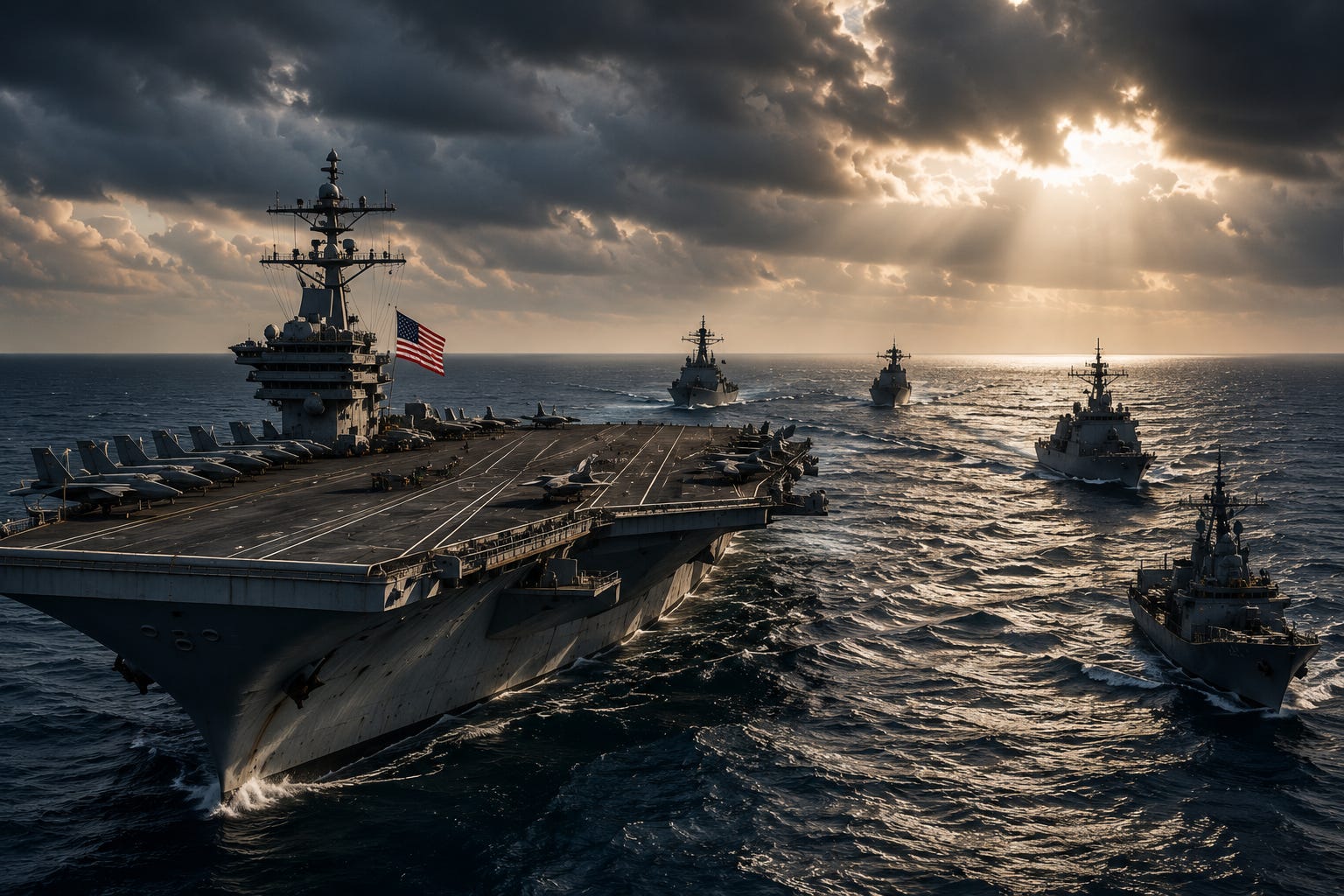
These are the number of years these three countries have been destabilizing forces in our hemisphere and worldwide. Cuba is in its 67th year of the Revolution and is already considered a failed state, with little time left to survive in its present condition before a transition occurs. The contingent of an Aircraft Carrier Battle Group is in situ, and several high-level meetings have taken place. We expect a resolution soon. Conditions on the ground are inhumane, and there is little the current government can do to survive this calamity.
Cuba has been responsible for revolutionary movements in Nicaragua, El Salvador, Colombia, Venezuela, Grenada, and Africa. Chávez-Maduro in Venezuela attempted to start one with Che Guevara in Bolivia. They have trained and hosted terrorists from Colombia (M-19, FARC, ELN), El Salvador (FMLN), and Nicaragua (FSLN), as well as dictators like Allende in Chile and Noriega in Panama.
Iran is in the 47th year of its Theocratic Revolution and has been one of the most destabilizing forces worldwide during this period. Iran and its proxies (Hamas, Hezbollah, Houthis, and the Alawites under Bashar al-Assad) tried to expand the Shiite movement from Iran through Iraq, Syria, and Lebanon, but found themselves stopped in their attempt to derail the Abraham Accords with Hamas’s attack on Israel on October 7, 2023.
Consequently, they reactivated the conflict with Hezbollah when they attempted to open a second front on October 8, 2023, also bringing in the Houthis on October 19, when they fired a barrage of missiles toward Israel. They expanded the conflict in November 2023 with the maritime blockade, all orchestrated by Iran. But later, when Bashar al-Assad was ousted in 2024 after a 13-year civil war, the plan crumbled. Still, they continued destabilizing the region through these open fronts.
Let us never forget that Hezbollah and Islamic Jihad, trained by the Iranian Revolutionary Guards (Quds Forces), were responsible for the October 1983 bombing of the Marine barracks, which killed 241 Marines and 58 French soldiers. They also bombed the U.S. Embassy in April 1983, as well as the embassy annex in September 1984.
It was Hezbollah who murdered Robert Stethem by shooting him in the neck and throwing him onto the tarmac in Beirut on June 15, 1985, after the 17-day hijacking ordeal of TWA Flight 847.
And for those who have also forgotten the hijacking of the cruise ship Achille Lauro on October 7–10, 1985, by the PLO (Palestinian Liberation Organization), another proxy of Iran at that time, they killed Leon Klinghoffer, a Jewish American citizen, who was executed with bullets to the head and chest. His body, along with his wheelchair, was dumped overboard in the Bay of Tartus, Syria.
Iran will also have to submit. Sanctions and blockades have strangled its economy. And yes, they agreed to sign a peace treaty that will stop their pursuit of the bomb, or so we think. But oil will flow, and the world economy will breathe again.
The Chinese have been quiet, and their late spring trimester (March, April, May) has shown a decline in manufacturing, dropping below 50% in May. They also have a lot at stake.
Mr. Putin spoke to President Trump on his birthday for 55 minutes and to Zelensky for around 35 minutes. So something may come from that. Trump is on his way to the G7 with momentum behind him after achieving the agreement with Iran, and may possibly be in Switzerland to personally sign the treaty.
He will ask Great Britain and France to assist in demining the Strait of Hormuz, and hopefully, the bottleneck of ships will begin moving out of the Persian Gulf as the economy sails into the autumn months and gears up for Christmas and New Year’s sales.
China had its scheduled meeting with Trump, and that needed to happen. Immediately afterward, Putin went running to his handler, Xi Jinping, to sign more commercial ventures, but really to understand what Trump had told him.
Needless to say, after a seven-year lull, Xi Jinping visited Pyongyang and reminded little Kim, who provides 90–98% of North Korea’s foreign trade, as well as oil deliveries, food, and basic staples.
Call it good news or whatever you like, but changes are coming. Cuba is next.
Conclusion
The 27/47/67 Axis represents more than isolated authoritarian regimes; it reflects a long-standing architecture of disruption that is increasingly under pressure. As Iran faces containment, China recalibrates, and Russia maneuvers for leverage, the global balance of power appears to be shifting. In this context, Cuba’s internal collapse and strategic isolation may place it at the center of the next decisive transition in the hemisphere.
Author
Lt. Colonel Octavio Pérez is a U.S. Army intelligence officer with more than two decades of active-duty service and additional reserve assignments focused on intelligence, security, and Nuclear, Biological, and Chemical Warfare. He commanded operations at Fort Leonard Wood, served in the Republic of Korea, and later joined the Defense Intelligence Agency, where he analyzed North Korean military capabilities and supported crisis responses to the Achille Lauro and TWA 847 incidents. Pérez volunteered with the 1st Cavalry Division during Desert Shield/Storm and subsequently became Chief Intelligence Instructor at the U.S. Army School of the Americas, training Latin American officers in low-intensity conflict. His reserve career culminated at U.S. Southern Command (SOUTHCOM), where he served as a strategic intelligence officer in J2 Operations, supporting hemispheric security missions.
The opinions expressed in this article are those of the author and do not necessarily reflect the views of the Miami Strategic Intelligence Institute (MSI²).
Colonel Pérez' analysis of the 27/47/67 axis is exceptionally sharp in the way it connects Cuba, Iran, and Venezuela as long-standing architectures of destabilization, and it does so with a strategic clarity that few writers manage to achieve. What stands out most is how convincingly you tie Cuba’s internal erosion to the broader regional realignment, making the piece both timely and analytically strong.
This is the kind of articles that demonstrates why Colonel Octavio Perez is one of the most notorious authorities in strategic analysis.