

🇺🇲 Commentary - Who Is Raúl Castro?
Frank Zimmerman, Senior Guest Analyst, MSI²

Executive Summary
The figure of Raúl Castro occupies a central place in the evolution of contemporary Cuban power. Through a historical review spanning from the Moncada assault to the Brothers to the Rescue case, key moments linked to the consolidation of the Armed Forces, state security, international operations, and the regime’s politico-military structure are examined, offering a perspective on the mechanisms of continuity of power in Cuba.
In a previous article, “Why Raúl Castro?”, I began from an uncomfortable premise: in Cuba, power is rarely where the regime wants us to look. Díaz-Canel manages the system; Raúl built it. One occupies the office; the other designed the machinery: Armed Forces, intelligence, military economy, repression, and succession.
The next question is even more uncomfortable: Who is Raúl Castro, really?
The indictment of Raúl Castro in the United States for the shootdown of the Brothers to the Rescue aircraft brought him back into public debate. Yet much of the traditional press continues to treat him with indulgence: a retired old man, a relic of the Cold War, Fidel’s younger brother, rather than an architect of power.
The shootdown was neither an accident nor improvisation: it was a state decision. Raúl was Minister of Defense; the federal indictment places him within the chain of command, and an audio recording revealed by The Miami Herald reportedly captures him acknowledging shootdown instructions. Fidel, in an interview with Dan Rather, also assumed political responsibility for the crime.
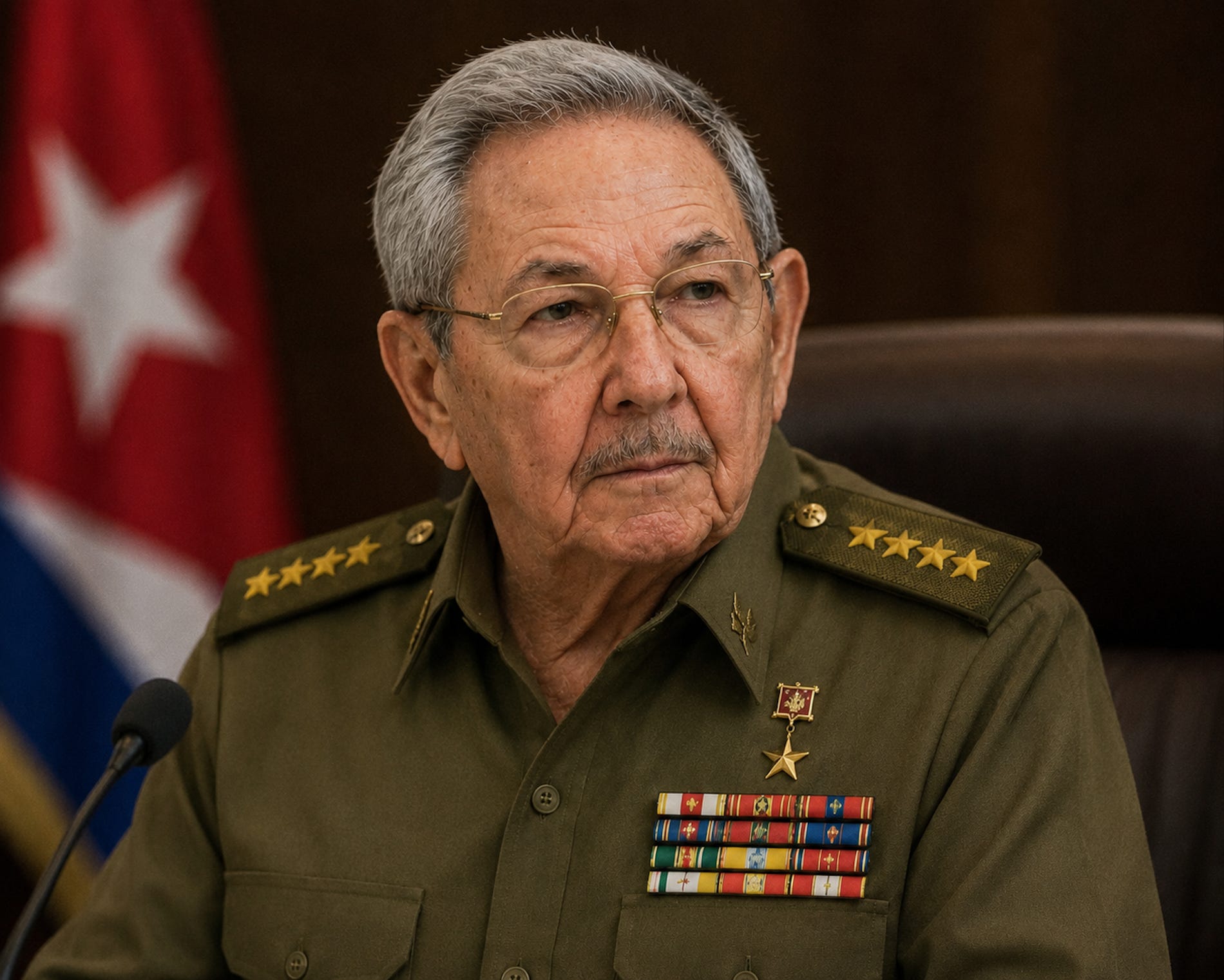
For this reason, Raúl’s indictment should not be interpreted as an isolated response to the 1996 crime, but rather as the most visible judicial point of a much longer trajectory. Brothers to the Rescue is not an exception in his biography. It is a consequence.
Raúl did not arrive late to communism. Before the assault on the Moncada Barracks in July 1953, he was already moving within its networks: he traveled to Eastern Europe for youth activities linked to the Soviet bloc and, upon returning, met Nikolai Leonov, a future high-ranking KGB official and a key Soviet figure in Latin America.
Soon afterward came Moncada. Propaganda would turn it into an epic; in reality, it was a poorly conceived, bloody, and defeated armed operation. The attack left 18 dead and 28 wounded among soldiers and military police; Bayamo recorded one dead and two wounded, in addition to nine civilians killed in Santiago.
Before becoming a myth, Moncada was an armed action with real deaths and concrete victims. Raúl commanded nothing: he joined a small group sent to the Palace of Justice under Léster Rodríguez. The mission failed; he escaped, removed his uniform, and was arrested the following day, without any glory.
Then came prison and amnesty. Despite the deaths at Moncada, Batista granted amnesty to the Castro brothers in May 1955, less than two years later. Fidel had received a fifteen-year sentence; Raúl was also convicted. Neither served five years. The supposed tyrant pardoned his armed attackers.
Then came Mexico, the Granma, and the Sierra Maestra. During those armed skirmishes against Batista, later inflated by propaganda into a guerrilla epic, Raúl was given command of the Second Eastern Front “Frank País” in Mayarí Arriba. There, he revealed his true profile: territorial organizer, disciplinarian, administrator of coercion and obedience.
That pattern of violence was not limited to ground combat. On November 1, 1958, militants of the 26th of July Movement hijacked Cubana Flight 495, on the Miami–Varadero–Havana route, to deliver resources to Oriente. The operation was coordinated from the Second Front under Raúl Castro’s command and ended with most of its passengers dead. Even before 1959, Castroism had already incorporated hijacking, coercion, and disregard for civilian life as methods of struggle.
The arrival of Castroism to power revealed the nature of that machinery. In Santiago de Cuba, Raúl remained as military chief of Oriente, responsible for the January executions, especially those at Loma de San Juan. That so-called “revolutionary justice” did not restore the rule of law; it inaugurated a pedagogy of fear.
The trial of the airmen in Santiago de Cuba, whose first proceeding concluded in acquittals on March 2, 1959, confirmed that logic. When that court acquitted pilots, gunners, and mechanics of Batista’s Air Force, Raúl Castro, then military chief of Oriente, ordered a second trial. The sentence had to conform not to evidence, but to revolutionary will.
On October 16, 1959, Raúl was appointed Minister of the Revolutionary Armed Forces. From MINFAR, he transformed Cuba into an international platform for subversion and expeditionary warfare. Across Latin America, beginning in 1959, the regime trained guerrillas, supported armed movements, and distributed intelligence, financing, and logistics. Not without reason was Cuba included in the U.S. list of State Sponsors of Terrorism in 1982.
In Africa, the scale was greater. Angola and Ethiopia were the visible cases, but Cuba also sent troops, advisors, or military support to Algeria, Congo, Guinea-Bissau, Mozambique, and other fronts. More than 380,000 military personnel participated. The official figure recognized by Cuba is 2,289 deaths, although other estimates raise the toll to several thousand, even as high as 10,000, according to General Rafael Del Pino.
For Raúl, Africa consolidated MINFAR as an expeditionary army, intelligence apparatus, and the backbone of Castroism. The Ochoa case in 1989 completed that architecture: under the appearance of a corruption and drug trafficking trial, it executed a prestigious general, weakened the Fidelist Ministry of the Interior (MININT), and definitively strengthened Raúlist military power.
The same logic repeated itself in the massacre of the 13 de Marzo tugboat in 1994. Cubans were attempting to escape; the State responded with violence. The point is not to claim that Raúl issued every operational order, but to understand that these crimes occurred within a militarized, hierarchical, and impunity-driven state, sustained by the apparatus he created, directed, and protected.
There, true Raúlism is laid bare: socialism for the people and military crony socialism for the elite; an economy in which collective ownership serves as a mask for the control exercised by an armed caste.
Brothers to the Rescue may be the most viable judicial case. But Raúl Castro does not begin there: it culminates there. Before it came Moncada, the Second Front, Flight 495, the executions in Santiago, MINFAR, the mercenary wars, the Ochoa case, the 13 de Marzo tugboat, and GAESA.
It is not an isolated episode; it is the last visible curve of a long road of command, crime, and impunity.
Raúl Castro is not a historical retiree nor merely the younger brother of the myth. He is the architect of hardline Castroism. Fidel was the legend; Raúl, the machinery. And when the machinery kills, it must also answer to justice.
Conclusion
Raúl Castro’s trajectory allows for an understanding of the weight of military, intelligence, and economic institutions in the configuration of the Cuban state. The discussion surrounding his political role extends beyond formal leadership and points to a power structure built over decades, the effects of which remain relevant for understanding Cuba’s political dynamics.
Author
Frank Zimmerman is a Cuban American lecturer, journalist, and political consultant with a distinguished career in media, political communications, and geopolitical analysis. Having spent his childhood and adolescence in Cuba and later lived in the United States, Spain, the United Kingdom, Israel, and Argentina, he brings a broad comparative and cosmopolitan perspective to political and cultural affairs.
A political commentator and strategist, he is the author of the book 12 Myths About Cuba, among other publications, and regularly analyzes issues related to freedom, democracy, and authoritarianism in Latin America.
He currently serves as Senior Advisor and Senior Multimedia Producer at the Adam Smith Center for Economic Freedom at Florida International University.
Zimmerman studied at the School of Visual Arts, earned a Master’s degree in Spanish Language and Literature from the City College of New York (CCNY), and completed postgraduate studies at the City University of New York (CUNY).
Originally published in Infobae.
The opinions expressed in this article are those of the author and do not necessarily reflect the views of the Miami Strategic Intelligence Institute (MSI²).