

🇺🇲 Major SIG - How Artificial Intelligence Is Giving the United States the Upper Hand in The Iran War
Dr. Luis Noguerol, Co-Founder and Senior Fellow, MSI²

Executive Summary
Artificial intelligence has become a decisive force multiplier in the current U.S. military campaign against Iran. By integrating AI with satellite systems, sensors, and telecommunications networks, the United States has significantly enhanced its ability to detect, process, and act on battlefield information at unprecedented speed. This technological advantage is reshaping modern warfare and giving U.S. forces a measurable operational edge.
Why This Matters
The integration of AI into warfare is not just a tactical development but a strategic transformation with global implications. The ability to compress decision-making timelines, dominate information flows, and disrupt adversary systems alters the balance of power in modern conflict. Understanding this shift is essential for anticipating future military dynamics and the risks associated with increasing reliance on autonomous and semi-autonomous systems.
When the latest war with Iran began, much of the world focused on the number of missiles fired and the list of targets hit. What has taken longer to digest is how deeply artificial intelligence now sits at the center of the United States’ military advantage. The current campaign is not just another chapter in a long confrontation with Tehran. It is the first time we can clearly see what happens when modern AI algorithms, satellite networks, and advanced telecommunications systems all work together in real combat and not just in exercises or classified tests (Interesting Engineering, 2026; Washington Post, 2026).
What stands out is not one secret weapon, but a whole way of fighting: a style of warfare where software helps decide what the military sees, how it understands that information, and how fast it acts. In that environment, Iran is trying to fight a country that can process a torrent of data from space, air, sea, and cyberspace faster than any human team could hope to manage. That speed and clarity give the United States a real edge on the battlefield.
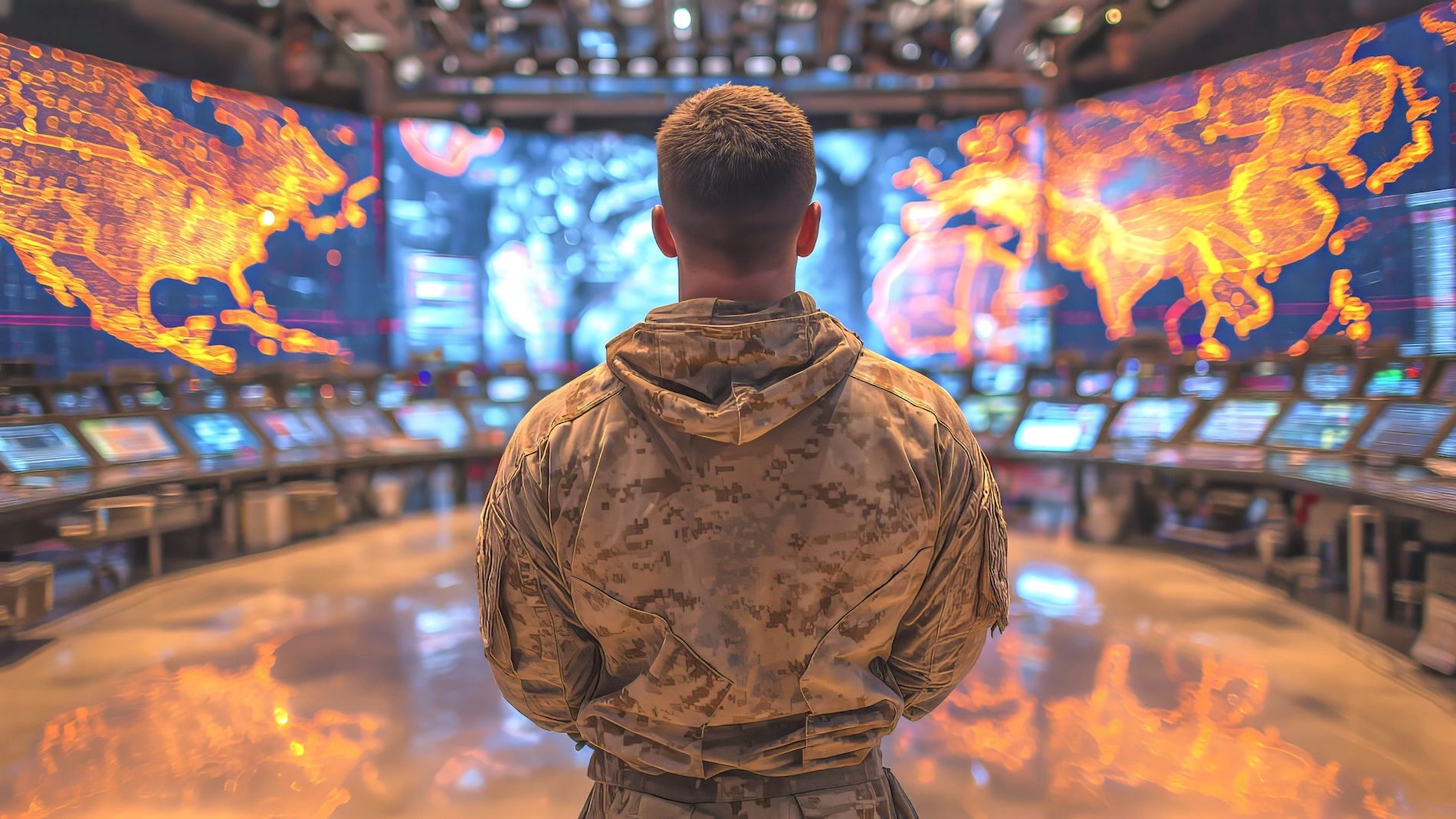
Satellites, Sensors, And AI: Seeing the War Before Iran Does
A large part of the U.S. advantage comes from how it uses satellites and other sensors. For years, the United States has had better eyes in the sky than any rival. What has changed now is how those eyes are “connected” to artificial intelligence. High-resolution satellite images are used to arrive in thick digital folders for intelligence analysts to review manually. Today, AI models scan those images as they come in, flagging movement near missile sites, changes at air bases, new trenches, fresh craters, and unusual activity around infrastructure that matters for the war (Interesting Engineering, 2026).
The same thing is happening with radar, drone video, and intercepted radio and cellular communication. Instead of treating each stream separately, modern AI systems fuse them together. A radar return that looks suspicious can be cross-checked against satellite photos and radio chatter almost instantly. If a convoy appears in a valley in western Iran, software can quickly ask: Have we seen these vehicles before? Are they linked to known units? Do they match the pattern of past moves before a missile launch?
This fusion is especially powerful in the satellite and telecommunications realm. Many military communications now ride on space-based links. AI models constantly monitor how signals flow through those networks, looking for disruptions or new patterns that might signal that Iran is preparing a cyberattack, moving mobile launchers, or trying to hide something in the noise of normal traffic (Fortune, 2026). In effect, the United States is not just watching Iran’s territory; it is also watching how Iran’s digital “nervous system” behaves.
Because AI can work through more data, more quickly, than any team of humans, the U.S. gets a standing early-warning system. Iran may still be able to surprise local defenders now and then, but it is much harder for it to move large forces, ready air defenses, or fuel missile batteries without leaving some trace in the data. The result is that Washington often “sees” the war a few steps earlier than Tehran, and that matters a lot.
Compressing Time: From Days of Planning to Minutes
The other big way AI is helping the United States is by shrinking the time between seeing something and acting on it. In past conflicts, the military might take days to confirm a target, coordinate with allies, plan a strike package, and run the necessary legal and political reviews. In the current Iran campaign, those cycles have been compressed dramatically.
Reports describe tools like the Maven Smart System, which takes in a huge volume of classified data from satellites, drones, and other sources and automatically produces lists of potential targets, complete with coordinates and priority rankings (Washington Post, 2026). On top of Maven, the military has used large-scale language models to quickly summarize intelligence, compare options, and evaluate possible strike combinations (Washington Post, 2026).
This does not mean that computers are deciding on their own to pull the trigger. Human commanders still give the final order. But when AI has already prepared the menu of targets, estimated their importance, and suggested which sequence of strikes will do the most damage to Iran’s capabilities, it becomes easier and faster for leaders to say “yes.” Within the first twelve hours of the initial wave, U.S. and allied forces reportedly hit close to 900 sites, a pace that simply would not be possible without automated help sorting, ranking, and updating target lists (Interesting Engineering, 2026).
The same systems also help check on the results. After a strike, AI tools compare before-and-after satellite images, intercept post-attack communications, and estimate how much a given operation has actually set Iran back. That feedback loop helps planners decide where to focus next. Did that series of attacks really cripple air defenses in a certain region? Are there signs that backup systems are coming online somewhere else? The answers come faster because AI does much of the heavy lifting.
This compression of time is one of the clearest signs that AI is giving the United States a winning edge. Iran’s leaders now have to react to a military that can see, decide, and strike on timelines measured in minutes and hours, not days. That makes it harder for Iran to hide, regroup, or shape the pace of the war in its favor.
Telecommunications: Listening, Jamming, And Protecting
Modern war is not just about bombs and missiles; it is also about who can keep talking and who can cut the other side’s voice. Here again, artificial intelligence wrapped around telecommunications systems is working in favor of the United States.
Iran has long invested in cyber tools and electronic warfare, and there is every reason to believe it is trying to use AI to make its own attacks sharper and more targeted (Fortune, 2026). But the flip side of that story is that the United States and its partners are using AI to defend their networks and to probe Iran’s. Models trained on years of traffic can spot unusual connection patterns, strange bursts of activity at odd hours, or subtle attempts to route data through compromised points. They can flag possible intrusions faster than human teams reading logs line by line (Fortune, 2026).
On the offensive side, AI helps identify which nodes in Iran’s telecom and internet infrastructure are most critical. Taking down one satellite uplink, for example, might interrupt several layers of military communication and radar feeds. Disrupting a specific fiber route might isolate a command center from its units. AI is good at finding these “choke points” in complex networks, suggesting where limited cyber or electronic warfare efforts can have maximum impact.
This is not just theory. The same kinds of tools used to map and optimize commercial networks are now being adapted to analyze Iran’s systems. Once those key points are identified, the United States can combine cyberattacks, electronic jamming, and physical strikes to blind Iranian defenses at the moment it needs them most. When Iran cannot reliably communicate with its own forces or understand what is happening in real time, U.S. forces gain the freedom to move, strike, and withdraw with less risk.
At the same time, protecting U.S. and allied communications is just as important. AI systems monitor their own satellite and radio networks for signs of jamming or tampering, automatically shifting to backup channels or adjusting signal parameters to stay connected. In this way, AI acts like an always-awake network engineer and security guard, constantly tweaking and defending the system so that the U.S. side can keep talking even under heavy pressure.
Why Iran Is Struggling to Keep Up
None of this means Iran is helpless or incompetent. It has talented engineers, a long history of cyber activity, and a willingness to experiment. However, there are structural reasons why the United States enjoys a big advantage when AI, satellites, and telecommunications all come together.
First, the United States has access to a far larger and more sophisticated satellite constellation, including military and commercial platforms that can share data when needed (Interesting Engineering, 2026). That provides more raw material for AI systems to analyze. Second, U.S. tech companies and defense contractors are at the cutting edge of large-scale AI, which makes it easier to build and deploy custom models for military use (Washington Post, 2026). Third, the United States has stronger partnerships with allies who bring their own sensors and networks into the mix. Israel, NATO partners, and private firms are part of this ecosystem, which multiplies the sources of information and the tools available to process it.
Iran does not have that depth of partners, nor the same access to advanced chips, cloud infrastructure, and commercial AI talent. While it can still launch missiles, move forces, and carry out cyberattacks, it is constantly facing an opponent that sees more, understands more, and adjusts faster. That is a hard gap to close in the middle of a war.
As a result, even when Iran shows creativity or resilience, the broader picture still tilts toward U.S. advantage. When its networks are probed, AI-driven defenses can blunt or at least slow the impact (Fortune, 2026). When it tries to disperse or hide critical assets, AI working with satellites often spots the move quickly enough for a response. When it attempts to overwhelm defenses with many actions at once, the U.S. side can still lean on software to sort urgent threats from noise.
The Quiet Risk Behind the Advantage
It is easy to look at this picture and declare that the United States is “winning” the AI race in the Iran conflict, and in many ways, that is true. Better use of artificial intelligence in satellite operations, targeting, and telecommunications is clearly helping Washington hit more targets, protect its own forces, and keep pressure on Tehran.
But there is also a quiet risk that comes with this advantage. The more the military leans on AI tools, the harder it becomes to slow down or step back. When planners are used to getting instant summaries and ranked target lists, older, slower methods start to feel unacceptable. That can narrow the space for caution and political debate.
There is also the danger of overconfidence. AI systems can be wrong, especially when used in new environments or against an adaptive enemy. If those errors are not caught, they can spread quickly through the system. In a war like the one with Iran, that is bad enough. In a future confrontation involving other great powers, the stakes would be much higher.
Still, if we focus on the current conflict, the pattern is clear. The United States is not ahead because of a single magic weapon, but because it has found ways to plug AI into the full chain of satellite observation, telecommunications, planning, and execution. That integration allows American forces to see further, react faster, and coordinate more tightly than Iran can manage. For now, in this war, that is what winning with AI looks like.
Three key takeaways
Artificial intelligence is enabling the United States to process and act on battlefield data faster than its adversaries.
The integration of AI across satellites, sensors, and telecommunications systems is transforming modern warfare.
The growing reliance on AI introduces new risks, including overconfidence and reduced space for human judgment in critical decisions.
References
Fortune. (2026, March 1). Iran could use AI to accelerate cyberattacks on U.S. and allies.
Interesting Engineering. (2026, March 3). Iran war exposes the expanding role of AI in military strike planning.
The Washington Post. (2026, March 4). Pentagon leverages AI in Iran strikes amid feud with Anthropic.
The opinions expressed in this article are those of the author and do not necessarily reflect the views of the Miami Strategic Intelligence Institute (MSI²).
As always, Dr. Noguerol reveals a new dimension—one that many would not even dare to imagine exists. And, to top it all off, it has been under development for years. Yet, we invariably end up with the same co-conspirators: China, Iran, North Korea, and Russia.
In this instance, China acts as the master puppeteer that assembled this puppet in Iran. Beginning in 2010, they started establishing command-and-control chains using dedicated telecommunications—eventually incorporating fiber optics, closed-circuit camera systems, and, finally, artificial intelligence.
In his analysis, the Doctor methodically describes how this new front—or dimension—is increasingly dominating decision-making processes and shaping the very unfolding of the battle.
Thank you for opening our eyes to this new reality.